
We proudly declare that Tobermore is the first to market in publishing Environmental Product Declarations (EPDs) for their paving, walling and kerb products (over 400 products). That took a lot of time, effort and expense.
Which brings about the question:
If there are so many green certification schemes available, what makes EPDs so special that Tobermore would make such an investment?
Here’s the quick answer:
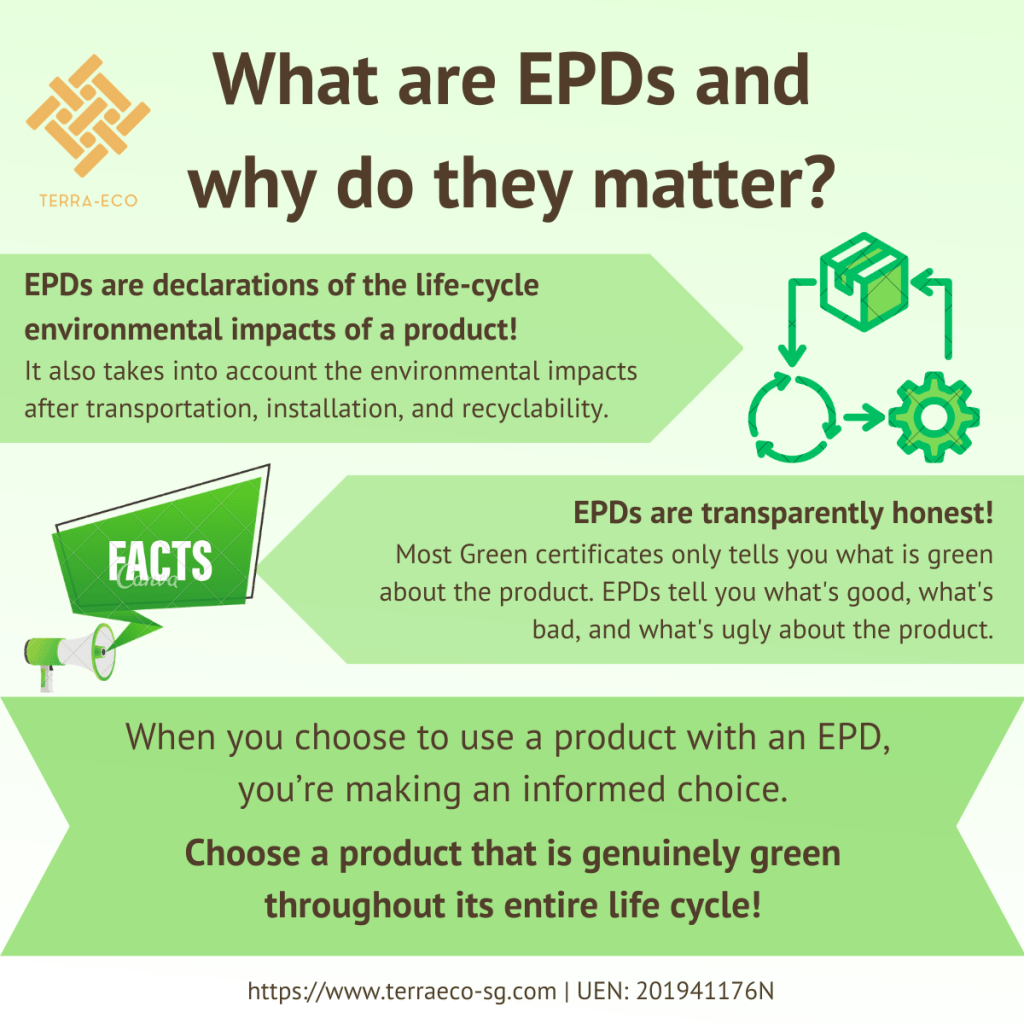
Here’s a more detailed explanation:
1. What are EPDs?
EPDs are, in a word, declarations. That means every environmental impact across a product’s life-cycle environmental impact is transparently assessed and declared. It’s about as honest an assessment as you can get.
EPDs join the long list of “Green” certification/assessment schemes available internationally. Even in Singapore, we have our own, including the Singapore Green Building Product scheme and the Green Mark certification scheme.
2. What’s the difference between EPDs and other Green Certifications
Very simply: Whilst green certifications tell you that a product meets certain green requirements, EPDs tell you in which areas a product is green AND in which areas a product is lacking or harmful to the environment.
I like the analogy from the Irish Green Building Council: “EPDs are like nutrition labels.”
When you get a product with a green certificate, you only find out all the ways in which it is green. But you do not get any information about the negative, life-cycle environmental impacts that it may or may not have.
With EPDs, you get all the information – the good, the bad, and the ugly. With this information, you can make more informed choices.
Furthermore, many green certifications only assesses a product’s sustainability value from manufacture to purchase (some do include the packaging and transportation stages as well).
EPDs, on the other hand, assesses a product’s environmental impact from cradle-to-grave.
In short, EPDs are more transparent and thorough than green certificates, in general.
3. Why don’t more companies get EPDs instead of Green Certifications?
1. EPDs are costly and troublesome to procure
There’s no denying the cost and trouble it takes to procure an EPD. With over 400 products on Tobermore’s list, that was quite an investment. Additionally, they only have a 5 years validity, after which, a new investment has to be made.
Tobermore’s EPDs are valid until 2027.
2. EPDs are transparently honest
It is difficult to hide behind an EPD – not when it assesses every single potential environmental impact, instead of just telling you the good things.
To choose to do so is to boast – that there’s nothing to hide from the manufacturing to the transportation to the installation to the products’ recyclability when they are no longer needed.
So, why does it matter that we have EPDs?
EPDs are a far superior and more revealing assessment of our building materials than many other green certifications.
When you choose to use a product with an EPD, you’re choosing to work with a product that isn’t just “green” on its surface. Rather, you’re choosing to find out if it’s “green” and genuinely environmentally-friendly throughout its entire life-cycle.
If you’re looking to make an informed choice about the green/sustainable building materials you’d like to use in your next project, contact us. We’re more than happy to provide you with all of Tobermore’s EPDs and Certifications.


 Terra-Eco Pte. Ltd.
1 thought on “What are EPDs and Why do they matter?”